
Dental Implants
WHAT IS DENTAL IMPLANT TREATMENT? PROCEDURE, COSTS, AND WHAT YOU NEED TO KNOW
Dental implant treatment is a solution for restoring missing teeth, helping improve chewing ability and aesthetics. Join Bảo An Dental to learn about implant structure, the procedure, costs, and important considerations before implantation.
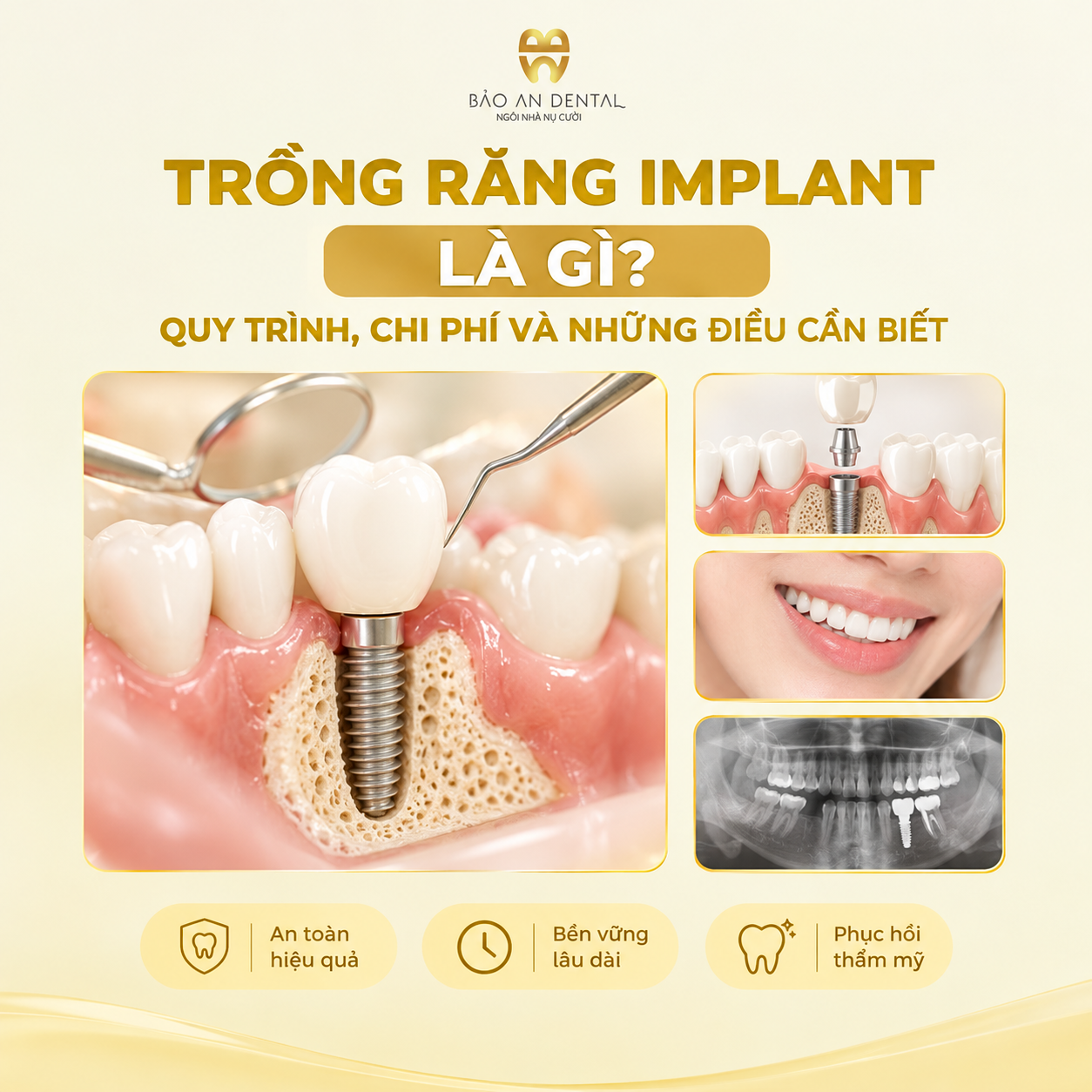
I. WHAT IS DENTAL IMPLANT TREATMENT?
Dental implant treatment, or implant placement, is a method of restoring missing teeth by placing an implant post into the jawbone to replace the tooth root. Once the post has stably integrated with the bone, the dentist will restore the upper crown to recover the tooth’s shape and chewing function.
Unlike dental bridges, which require adjacent teeth to serve as supporting abutments, an implant can be placed independently at the missing-tooth site, helping minimize the need to file down neighboring natural teeth.
The structure of a dental implant consists of three main components:
Implant post
This is the artificial tooth root placed into the jawbone.
It is commonly made from titanium or materials specially designed for dental implantation.
It supports the restoration above after integrating with the jawbone.
Abutment
This component connects the implant post to the ceramic crown.
It helps support and secure the restored crown.
It is selected according to the implant position and tooth design.
Ceramic crown
This is the visible outer portion of the tooth.
It is designed with a shape, size, and color that match the remaining teeth.
It supports chewing and improves smile aesthetics.
The combination of these three components makes implants a fixed tooth restoration solution that meets both functional and aesthetic needs.
II. WHAT CONSEQUENCES CAN OCCUR IF LONG-TERM TOOTH LOSS IS NOT RESTORED?
After a tooth is lost, the jawbone in that area no longer receives mechanical stimulation as before. Over time, the bone may decrease in height and volume. In addition, the remaining teeth may also be affected by changes in chewing forces and gaps in the dental arch.
1. Jawbone loss at the missing-tooth site
The jawbone may gradually resorb when a natural tooth root is no longer present. The degree of bone loss depends on how long the tooth has been missing, the initial bone condition, and many other factors.
When bone volume is no longer sufficient, implant placement may become more complex. Some cases need to be assessed for bone grafting or require supportive procedures before the implant post is placed.
2. Changes in facial contours
When multiple teeth are missing or tooth loss persists for a long time, bone resorption and soft-tissue changes may contribute to the cheeks and lips losing their natural support.
This may make the face appear less full, especially in cases of multiple missing teeth or complete tooth loss.
3. The remaining teeth may shift
The gap left by a missing tooth can cause adjacent teeth to tilt toward the space. Opposing teeth may also over-erupt due to the lack of contact during chewing.
These changes can make the bite unstable and make certain areas more difficult to clean.
4. Reduced chewing ability
Tooth loss, especially of molars, can make it difficult to grind food. People with missing teeth tend to chew on one side or have to choose softer foods.
If prolonged, changes in eating habits may affect quality of daily life.
5. Effects on pronunciation and confidence
Gaps in the front-teeth area can affect the pronunciation of certain sounds. In addition, noticeable tooth loss may make some people reluctant to smile or less confident when communicating.
Note: Not every case of tooth loss presents all of the effects above. However, early examination helps the dentist assess oral health and select an appropriate time for restoration.
III. ADVANTAGES AND DISADVANTAGES OF DENTAL IMPLANT TREATMENT
Implant placement offers many benefits for restoring missing teeth, but it also involves health, time, and cost requirements that should be considered.
1. Advantages of dental implant treatment
Restores chewing ability
The implant post is supported by the jawbone, providing a foundation for a fixed restoration. Once completed and assessed as suitable by the dentist, an implant tooth can effectively support chewing.
Minimizes impact on adjacent natural teeth
For a single missing tooth, an implant can be restored independently without filing down the two adjacent teeth, unlike traditional dental bridges.
Helps maintain jawbone at the missing-tooth site
The implant post transfers chewing forces to the supporting bone, helping maintain the bone around the implant. However, implants do not completely eliminate the risk of bone loss or changes in the tissues around the implant.
Ensures aesthetics
The ceramic crown is designed with a shape, size, and color that match the dental arch. If properly planned, an implant tooth can achieve a natural aesthetic appearance.
Can be used long-term
The Implant post is made of Titanium, which is highly biocompatible, with an average lifespan of 20 years or more. If performed with proper technique and cared for and maintained correctly, Implant teeth can last a lifetime, helping maintain long-term chewing function and aesthetics.
Cost-effective, long-lasting results
For cases of full-arch tooth loss, All-on-4 or All-on-6 Implant techniques use 4 or 6 Implant posts to support the entire restored dental arch, eliminating the need to place an individual post for each tooth. This method helps optimize costs, restore chewing function, and maintain long-term effectiveness when properly cared for.
2. Disadvantages and considerations
Relatively high initial cost
Compared with removable dentures or certain dental bridge methods, Implants generally have a higher initial cost because they require implant posts, restorative components, and a surgical procedure.
Completion time may be prolonged
In many cases, Implant posts need time to integrate with the jawbone before the final restoration can be completed. Total treatment time may take 3–4 months or longer if bone grafting, sinus lifting, or treatment of accompanying oral health issues is needed.
Surgery is required
Implant placement is a surgical procedure. After treatment, patients may experience swelling, soreness, or slight bleeding during the initial period. Some complications may also occur despite proper preparation and adherence to the procedure.
Requires long-term care and follow-up visits
Implant teeth still need daily cleaning and regular monitoring. Improper hygiene may increase the risk of inflammation of the tissues around the Implant, affecting the stability of the post.
IV. WHO IS SUITABLE FOR DENTAL IMPLANT TREATMENT?
Not all cases of tooth loss can receive Implants immediately. The dentist needs to assess overall health, jawbone condition, and soft tissues before making a recommendation.
1. Cases that may be indicated
People missing one or multiple teeth who need to restore chewing function.
People with full-arch tooth loss who require fixed restorations or Implant-supported restorations.
People who have been missing teeth for many years and want to assess their eligibility for Implant placement.
People with severely damaged teeth that cannot be preserved and need a restoration option after extraction.
People who wish to restore teeth while minimizing the reduction of adjacent natural teeth.
Specific eligibility depends on the examination results and the dentist's professional assessment.
2. Cases requiring postponement or careful assessment before treatment
Incomplete jawbone development: It is necessary to wait until the jawbone is stable.
Pregnant women: Treatment should be postponed until an appropriate time.
Uncontrolled systemic conditions: Such as diabetes, cardiovascular disease, blood clotting disorders, etc.
Oral infections: These need to be controlled before Implant placement.
Insufficient jawbone: Bone grafting or sinus lifting may be needed.
Smoking: Increases the risk of complications and affects healing.
Use of certain medications: The dentist should be informed for assessment.
V. WHAT IS THE DENTAL IMPLANT PROCEDURE LIKE?
The process below describes the stages commonly involved in an Implant treatment plan. When applied at Bảo An Dental, it should be aligned with the clinic's actual professional procedures and the indications of the responsible dentist.
1. Steps of dental Implant placement
Step 1: Examination and assessment of oral health
The dentist examines the missing-tooth area, gum tissue, remaining teeth, and bite condition. The patient is asked about medical history, medications currently being used, and factors that may affect treatment.
Step 2: Imaging and treatment planning
Depending on the case, the dentist may prescribe X-rays or a 3D Cone Beam CT scan to assess bone volume, the locations of important anatomical structures, and the implant placement direction.
Based on these results, the dentist advises on the Implant plan, restoration type, estimated timeline, and related costs.
Step 3: Preparation and placement of the Implant post
After confirming that the patient is eligible, the dentist performs the necessary preparation, infection-control measures, and appropriate anesthesia.
The Implant post is placed in the planned position. The procedure time depends on the number of posts, case complexity, and any additional procedures required.
Step 4: Monitoring healing and osseointegration
After surgery, the patient is given at-home care instructions and scheduled for follow-up visits. The dentist monitors the soft tissues, healing progress, and stability of the post.
During the waiting period, a temporary tooth may be used if appropriate for the clinical condition.
Step 5: Placement of the porcelain restoration
When the post is ready for restoration, the dentist takes an impression or performs a digital scan to design a suitable crown.
The crown is fabricated according to the plan, then attached to the Implant and adjusted at the contact points and bite to ensure function and comfort.
Step 6: Examination and long-term care instructions
After the restoration is completed, the dentist checks its stability and bite and provides instructions for cleaning around the Implant. The patient needs to maintain follow-up appointments to monitor the tissues around the post and the restoration.
2. How Long Does Dental Implant Placement Take? Key Timelines to Know
The time required for dental implant placement depends on the number of implants, jawbone condition, and each person's restoration plan.
Implant post placement procedure: It usually takes about 20–30 minutes for each implant post. The time may be longer if additional procedures are needed.
Initial healing stage: During the first 1–3 days, the implant area may be swollen and mildly painful; symptoms usually gradually subside after 3–5 days. Soft tissue typically needs several days to several weeks to recover.
Osseointegration stage: This usually takes about 2–6 months for the implant post to bond with the jawbone. The specific duration depends on bone quality, implant location, and oral health condition.
Final prosthetic tooth placement stage: Once the implant post reaches the necessary stability, the dentist will take impressions, fabricate, and place a crown or dental prosthesis. The timing depends on the extent of healing and the treatment plan.
Some eligible cases may receive early restoration or restoration within a shorter period. However, not everyone is suitable for this option.
VI. WHAT FACTORS AFFECT THE COST OF DENTAL IMPLANTS?
The cost of dental implant treatment at Bảo An Dental depends on the number of teeth to be restored and the method used. Specifically, a single implant costs from VND 12,000,000–30,000,000 per tooth.
Note: The price list is for reference only. The actual condition of the teeth and bone requires examination and imaging by a dentist to determine the treatment plan best suited to each customer's needs.
1. Type of implant post selected
Implant post lines differ in origin, surface treatment technology, and warranty policies, resulting in price differences.
2. Type of restorative dental crown
Premium ceramic crowns, such as multilayer Hi-Zirconia, typically cost more than standard ceramic options due to their ability to recreate natural color and translucency.
3. Dentist's expertise and dental equipment
The dentist's expertise, imaging system, and surgical support equipment may affect the cost of treatment.
4. Items included in the treatment package
When receiving a consultation, customers should clearly ask what the cost includes:
Implant post.
Abutment connector.
Ceramic crown.
Examination and diagnostic imaging.
Supporting procedures, if needed.
Temporary teeth, follow-up visits, and warranty policies under specific conditions.
Do not assume that all packages advertised as “all-inclusive” include the same items.
5. Additional costs
In addition to the all-inclusive implant cost, some cases may require additional supporting procedures such as bone grafting or sinus lifting if the jawbone is not yet suitable for implantation, increasing the total treatment cost.
6. How to choose an implant that fits your budget
To make a suitable choice, customers should:
Determine their restoration needs and the number of teeth to be treated.
Clearly learn about the origin and information of the implant post line being recommended.
Request a detailed cost estimate before treatment.
Discuss procedures that may incur additional costs.
Consider the long-term care, follow-up, and warranty plan.
VII. FACTORS AFFECTING IMPLANT RESULTS AND IMPORTANT NOTES
Dental implant results depend not only on the type of implant post but also on the treatment plan, technique, health condition, and post-surgical care.
1. Important factors
Dentist's expertise: The dentist needs to accurately assess the condition of the bone, soft tissue, and bite to develop an appropriate implant plan, while also monitoring and addressing any issues that arise.
Equipment and sterilization procedures: Appropriate diagnostic tools and infection-control procedures are important factors during implantation.
Material quality and origin: The implant post, abutment, and crown should have clear information and be appropriate for the indication and restoration plan.
Overall health: Underlying medical conditions, medications currently being taken, smoking habits, and oral hygiene status may affect the healing process as well as the health of tissues around the implant.
Post-treatment care: Proper oral hygiene, following instructions, and regular follow-up visits help maintain the long-term stability of the implant.
2. What to prepare before implantation
Provide complete information about medical conditions, medications currently being taken, and allergy history.
Undergo additional tests or examinations when indicated.
Maintain oral hygiene and address any necessary issues as instructed by the dentist.
Reduce or quit smoking based on professional advice.
Do not stop taking current medications on your own in preparation for surgery.
Arrange time for rest and follow-up appointments as scheduled.
3. Care after dental implant placement
During the first few days
Apply cold compresses to the outside of the cheek as instructed.
Prioritize soft, easy-to-chew foods that have cooled to a moderate temperature.
Avoid strong impact on the surgical area.
Do not rinse vigorously or spit repeatedly during the initial stage.
Use medication exactly as prescribed by the dentist.
During the healing period
Maintain gentle oral hygiene as instructed.
Avoid smoking and limit alcohol consumption.
Do not use the temporary tooth to bite or tear hard foods without authorization.
Attend follow-up appointments as scheduled to monitor the healing process.
After the restoration has been completed
Brush your teeth at least twice a day with a suitable toothbrush.
Clean the area where the Implant meets the gums using dental floss, an interdental brush, or the recommended tools.
Have regular check-ups to examine the tissues around the Implant and your bite.
Consult your dentist if you experience looseness, persistent pain, or unusual discomfort.
If pain progressively worsens, swelling spreads, fever, prolonged bleeding, or pus discharge occurs, patients should contact the dental clinic for timely assessment.
VIII. COMPARISON OF IMPLANTS, DENTAL BRIDGES, AND REMOVABLE DENTURES
The three methods of replacing missing teeth have different characteristics and indications. The choice should be based on the number of missing teeth, the condition of adjacent teeth, jawbone, overall health, and budget.
Criteria | Implant | Dental bridge | Removable denture |
|---|---|---|---|
Suitable candidates | – Missing 1 tooth | – Missing 1 tooth | – Elderly individuals |
Conservativeness | – No need to reshape adjacent teeth | – Requires reshaping natural teeth | – May cause jawbone loss |
Aesthetics | Natural like real teeth | Good, natural-looking | Depends on the denture design |
Chewing ability | Good when the implant integrates with the bone and the restoration is stable | Fairly good, with relatively stable chewing | Limited, difficult to chew hard foods |
Treatment time | About 2–6 months | About 3–7 days
| About 5–14 days |
Longevity | Usually 20 years or more | About 5–15 years | About 3–5 years |
Care | Clean like natural teeth and attend regular check-ups | Difficult to clean beneath the dental bridge | Remove the denture for daily cleaning |
Reference cost | VND 12,500,000–30,000,000 per tooth | VND 1,000,000–18,000,000 per dental bridge | VND 300,000–500,000 per tooth |
Which method should you choose?
Implant: May be suitable for people who want a fixed tooth replacement and wish to minimize impact on adjacent natural teeth, provided they are eligible for implantation.
Dental bridge: May be a suitable option when the supporting teeth meet the requirements and the patient wants restoration in a shorter period of time.
Removable denture: May be suitable for people who need a less invasive option, have a limited budget, or have specific health-related indications.
There is no single optimal method for every case. The dentist will assess each condition to recommend a solution suited to actual needs and circumstances.
IX. COMMON MISCONCEPTIONS ABOUT DENTAL IMPLANTS
1. Does getting an Implant always require bone grafting?
Not all cases require bone grafting. This decision depends on the height, width, and quality of the bone at the planned implant site. The dentist will assess this through examination and diagnostic imaging.
2. Is it impossible to get an Implant after having missing teeth for many years?
Having missing teeth for many years does not mean implantation is impossible. However, bone loss may make the treatment plan more complex. Some cases require bone grafting or supportive procedures beforehand.
3. Does getting an Implant hurt?
During implantation, the dentist uses appropriate anesthesia to control pain. After the procedure, patients may experience varying degrees of soreness, pain, or swelling. These symptoms should be monitored and managed as instructed.
4. Does getting an Implant once mean it will last forever?
Implants can be used long-term, but it cannot be guaranteed that they will last a lifetime in every case. The implant fixture, tissues around the Implant, and ceramic tooth restoration all require care and regular check-ups. Actual longevity depends on many factors.
5. Can older people get Implants?
Advanced age is not the only factor determining eligibility for implantation. The dentist needs to assess overall health, jawbone condition, medications being taken, and the ability to provide post-treatment care before making a recommendation.
6. Is long-term dietary restriction necessary after getting an Implant?
During the initial stage, patients usually need to prioritize soft foods and avoid placing strong force on the implant site. Once the restoration is stable, the diet will be adjusted according to the dentist's instructions. Choosing appropriate foods and chewing forces remains very important.
X. FREQUENTLY ASKED QUESTIONS ABOUT DENTAL IMPLANTS
1. Can I get an Implant if I have had missing teeth for many years?
Possibly. However, people with long-term tooth loss are at risk of bone loss at the missing-tooth site. The dentist needs to examine bone volume and soft tissue to determine implantation eligibility, while also considering bone grafting or supportive procedures if necessary.
2. What should I do if swelling occurs after getting an Implant?
Mild swelling may occur during the first few days after surgery. Patients should follow care instructions, apply cold compresses properly, and take medication as prescribed. If swelling progressively worsens, severe pain, fever, or abnormal signs occur, contact the dentist for an examination.
3. Is Implant dental hygiene difficult?
Cleaning Implants is not overly complicated, but it needs to be done correctly. In addition to daily brushing, patients need to clean the area where the crown meets the gums using appropriate tools and attend regular follow-up appointments.
4. Can people with diabetes receive Implant treatment?
Some people with diabetes can still receive Implant placement if their condition is appropriately controlled. The dentist needs to assess health indicators, medications being used, and factors that may affect healing before making a decision.
5. How long after Implant placement can normal chewing resume?
The timing for resuming chewing depends on the surgical condition, the stability of the implant post, and the restoration plan. Patients may need to eat soft foods during the initial stage and only gradually increase chewing intensity as instructed by the dentist.
6. Does Implant placement affect adjacent teeth?
Implants are designed to restore missing teeth independently. When planned accurately and performed with proper technique, this method helps minimize impact on adjacent teeth. However, the implant position still needs to be carefully calculated to protect surrounding structures.
7. Are follow-up visits necessary after Implant placement?
Yes. Follow-up visits help the dentist monitor the healing process, examine the tissues around the Implant, assess the bite, and detect any problems early. Even after the tooth has stabilized, patients should maintain regular check-up appointments.
CONCLUSION
Dental Implant treatment is one of the current methods for restoring missing teeth, helping to restore chewing function and improve aesthetics when appropriately indicated. However, the results depend on many factors, such as jawbone condition, overall health, treatment planning, implementation technique, and post-implant care.
If you are missing one tooth, multiple teeth, or have had missing teeth for a long time, you should seek an examination for a specific assessment before choosing a restoration method.
Bao An Dental accompanies you on your journey to care for and restore your smile.
Contact Bao An Dental for consultation and to schedule an appointment.